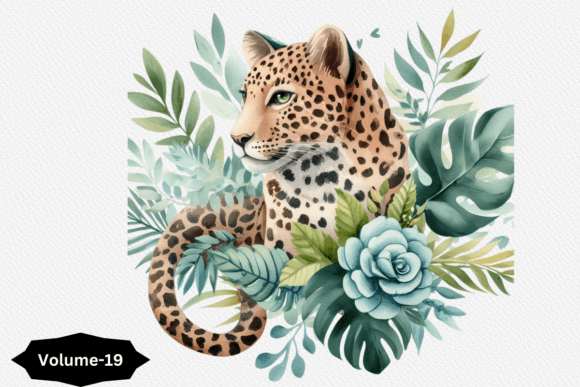
Watercolor Leopard Clipart Volume –19: Wild Elegance
There’s a certain energy that watercolor art brings to a project—it’s organic, slightly unpredictable, and full of life. When that technique is applied to animal patterns, like in the Watercolor Leopard Clipart Volume –19, the result is a digital asset that feels both artistic and authentic. This isn't just a simple graphic; it’s a piece of hand-painted texture ready to be incorporated into your creative work. The appeal lies in its imperfections—the way the pigment bleeds at the edges, the natural gradation of color, and the soft, non-uniform spots that mimic a real leopard’s coat. It’s this handmade quality that gives it a distinct personality, moving it far beyond a flat, vectorized pattern.
The Core Asset: What You Get
Your download of Watercolor Leopard Clipart Volume –19 is straightforward and designed for immediate use. It includes one high-resolution PNG file, meticulously crafted at 300 DPI and sized at a generous 3600 x 3600 pixels. This large canvas provides tremendous flexibility, allowing you to scale the design for various applications without losing clarity. The transparent background is crucial—it means you can drop this leopard pattern onto any surface, color, or photograph seamlessly. Whether you’re placing it on a stark white t-shirt mockup or a rich, dark editorial layout, the clipart integrates without the hassle of removing a background. It’s a ready-to-use component in your design toolkit.
Visual Character and Style
Looking closely at the Watercolor Leopard Clipart Volume –19, you’ll notice the style strikes a balance between realism and artistic interpretation. The rosettes aren’t perfect circles; they vary in size, opacity, and saturation, just as they would in a traditional watercolor painting. The color palette likely leans into warm, natural tones—think tawny golds, soft browns, and perhaps hints of deeper ochre or sienna. This makes it incredibly versatile for projects aiming for a nature-inspired, bohemian, or sophisticated safari aesthetic. The texture has a softness to it, avoiding the harshness of digital lines, which makes it feel approachable and gentle, perfect for certain branding or nursery decor contexts.
Practical Applications for Creators and Businesses
The real value of a design asset like Watercolor Leopard Clipart Volume –19 is measured by how many projects it can enhance. For entrepreneurs and small business owners, this clipart is a powerhouse for creating branded merchandise. Imagine it as a full-bleed pattern on a tote bag, a centered graphic on a coffee mug, or an accent on a set of stickers. Its high resolution ensures it looks crisp and professional on physical products, which is essential for selling items that customers will hold and inspect. You can print it on shirts, hats, cups, and stickers with confidence, knowing the detail will hold up.
For designers and content creators, the applications are equally broad. In digital spaces, it can serve as a striking background for social media graphics, adding depth and visual interest that stops the scroll. It works beautifully as an overlay in photo editing, allowing you to blend the leopard texture with portraits or product shots for a unique artistic effect. In publishing, think of a chapter opener in a lifestyle magazine or a thematic page in a scrapbook. The clipart can also be used to create custom wrapping paper, notebook covers, or even elements within a larger digital collage. Its utility spans from the highly commercial to the deeply personal.
Integrating the Clipart into Your Design Workflow
Using Watercolor Leopard Clipart Volume –19 effectively requires a bit of strategic thinking. First, consider the emotional tone of your project. This clipart conveys a sense of wild elegance, playful adventure, and natural beauty. It’s an excellent fit for brands or projects targeting audiences who appreciate artistry, nature, or a touch of exotic flair. It might be less suited for ultra-minimalist, corporate, or tech-forward aesthetics where clean, geometric forms dominate.
Next, think about composition. Because it’s a detailed, textured pattern, it can become visually busy. Use it as a background element and pair it with strong, simple typography—perhaps a clean sans serif font for body text or a bold display font for headlines—to create a clear visual hierarchy. Alternatively, use it as a focal point in a design with ample negative space. Testing is key. Place the clipart on your project mockup and evaluate it from a distance. Does it enhance the overall feel or compete with your message? Does the color palette complement or clash with your existing brand identity?
Finally, remember its commercial licensing allows you to sell the final printed products you create. This opens doors for passive income streams or expanding your product line. You are not just buying a graphic; you are investing in a reusable design asset that can generate value across multiple projects over time.
Elevating Your Creative Output
In a market saturated with generic digital assets, the Watercolor Leopard Clipart Volume –19 stands out because of its artisanal quality. It doesn’t just decorate; it adds a layer of sophistication and craftsmanship to your work. For a crafter, it might be the centerpiece of a handmade card. For a blogger, it could transform a standard post into a visually rich experience. For a marketer, it offers a way to connect with audiences on an emotional, aesthetic level that stock photography sometimes misses.
The key is to view it not as a single-use item, but as a versatile component. Combine it with other textures, layer it with solid colors, or use it to inspire an entire color scheme for a project. Its strength is in its ability to adapt while maintaining its core, beautiful character. By thoughtfully integrating Watercolor Leopard Clipart Volume –19 into your creative process, you leverage a piece of art that can genuinely elevate the professionalism and appeal of your final product, whether it’s digital or physical.